
Python3 继承与多态
2018-01-09 22:50:03
•
阅读
打赏
继承是用已写好的类的定义作为基础建立新类的技术,新类的定义能增加新的数据或新的功能,也能用父类的功能。
通过使用继承我们能够非常方便地复用以前的代码,能够大大的提高开发的效率。
继承
我们定义一个类的时候,如果从某个现有的类继承,新的累称为子类(Subclass),
而被继承的类称为基类、父类或超类(Base class、Super class)。
Python 支持类的继承。派生类的定义如下所示:
class DerivedClassName(BaseClassName1):
<statement-1>
<statement-N>
需要注意圆括号中基类的顺序,若是基类中有相同的方法名,而在子类使用时未指定,
python从左至右搜索 即方法在子类中未找到时,从左到右查找基类中是否包含方法。
BaseClassName(基类名)必须与派生类定义在一个作用域内。
除了类,还可以用表达式,基类定义在另一个模块中时就用这种写法:
class DerivedClassName(modname.BaseClassName):
方法重写
如果你的父类方法的功能不能满足你的需求,就在子类重写你父类的方法
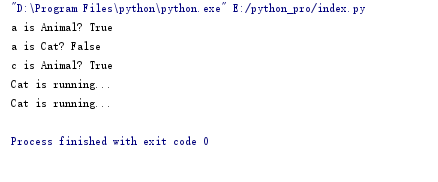
class Animal(object):
    def run(self):
        print('Animal is running...')

class Cat(Animal):
    # 子类增加新方法
    def eat(self):
        print('Cat eating fish...')
    # 子类重写父类方法
    def run(self):
        print('Cat is running...')

def run_twice(a):
    a.run()
    a.run()

a = Animal()
c = Cat()

print('a is Animal?', isinstance(a, Animal))
print('a is Cat?', isinstance(a, Cat))
print('c is Animal?', isinstance(c, Animal))

run_twice(c)
多继承
Python同样有限的支持多继承形式。多继承的类定义形如下例:
class DerivedClassName(Base1, Base2, Base3):
<statement-1>
<statement-N>
需要注意圆括号中父类的顺序,若是父类中有相同的方法名,而在子类使用时未指定,
python从左至右搜索 即方法在子类中未找到时,从左到右查找父类中是否包含方法。
运算符重载
Python同样支持运算符重载,我们能对类的专有方法进行重载
class Vector:
    def __init__(self, a, b):
        self.a = a
        self.b = b

    def __str__(self):
        return 'Vector (%d, %d)' % (self.a, self.b)

    def __add__(self ,other):
        return Vector(self.a + other.a, self.b + other.b)

v1 = Vector(2 ,9)
v2 = Vector(5 ,-3)
print (v1 + v2) # 输出 Vector (7, 6)





相关推荐
深度学习 -- 损失函数
深度残差网络(Deep Residual Networks (ResNets))
深度学习 -- 激活函数
神经网络训练 -- 调整学习速率
生成对抗网络(GAN)改进与发展
生成对抗网络(GAN)优点与缺点
生成对抗网络(GAN)的训练
生成对抗网络(GAN)基本原理
生成模型与判别模型